Posts

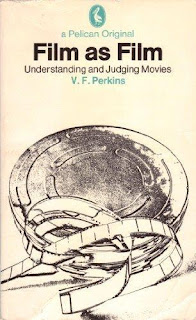
"Film as Film: Understanding And Judging Movies", V. F. Perkins
Image
Victor Francis Perkins (1936 – 2016) was a British film critic, teacher and co-founder of Movie magazine. He became known for his approach to the critical analysis of film without jargon. Film as Film (1972) is perhaps his most famous work, a seminal book on film studies that makes an accessible introduction to film theory and some of its history, while discussing mise en scène aspects (e.g.,   color changes, lighting techniques, camera movements), the fusion of form and content, the how and what, in Preminger, Hitchcock, Nicholas Ray, among other classic filmmakers. He also discusses the role of the filmmaker as an author, even in a commercial system with its financial and logistic restrictions. Excerpts: “Consider this sequence from Carmen Jones (…). The soldier hero, Joe, is driving a jeep down a country road. Beside him sites his prisoner Carmen, whom he has been ordered to deliver to the civilian authorities in a near-by town. As the jeep speeds along, Carmen mak...

"Agee on Film", James Agee

Image
James Agee (1909-1955) was an American novelist, journalist, poet, screenwriter and film critic. He wrote A Death in the Family (1957), which won him a posthumous 1958 Pulitzer Prize. With photographer Walker Evans, he documented the lives of sharecroppers in Alabama during the Great Depression, which later resulted in the book Let Us Now Praise Famous Men (1941). He was also a screenwriter, having contributed to two of the most admired films from the 1950s: The African Queen (1951) and The Night of the Hunter (1955). He died from a heart attack in a New York taxi at the age of 45, in 1955. Agee was the most important American film critic in the 40s. He wrote for Time and The Nation , and was a great enthusiast of Charles Chaplin [Agee was possibly the critic who most defended Monsieur Verdoux (1947) in America at a time when it was receiving a poor reception], John Huston, and an admirer of Laurence Olivier’s filmic adaptations of Shakespeare and the horror / fantasy...

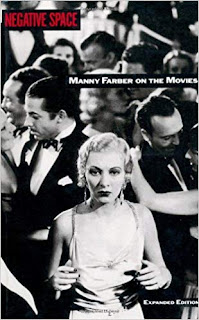
"Negative Space: Manny Farber on the Movies", Manny Farber

Image
Manny Farber (1917–2008) was a painter and film critic, regularly contributing to publications such as The New Republic, The Nation, Artforum, Film Culture, and others. He was distinguished by its inventive, iconoclastic writing, and for being a defender of action– Howard Hawks, Samuel Fuller, William Wellman, Raoul Walsh, Anthony Mann – and underground filmmakers, like Michael Snow and Andy Warhol. One of his most remembered essays is "White Elephant Art vs. Termite Art", in which he writes about the virtues of "termite art", the excesses of "white elephant art", by championing the first, “where the spotlight of culture is nowhere in evidence, so that the craftsman can be ornery, wasteful, stubbornly self-involved, doing go-for-broke art and not caring what comes of it”, against the second, that treats “every inch of the screen and film as a potential area for prizeworthy creativity” and lacks the economy of expression of “termite art”. Negative Space...

"The Magic World of Orson Welles", James Naremore

Image
James Naremore is a film scholar and a retired professor of Communication and Culture, English, and Comparative Literature. In The Magic World of Orson Welles (which, according to Jonathan Rosenbaum, is “the best critical study of Welles available in any language”), Naremore makes an authoristic study of one of the most beloved filmmakers, through deep stylistic and thematic analysis of each one of his films that also include considerations of Welles’s liberal politics, biographical aspects and historical context. His radio work and theatre plays are also reviewed, and his unfinished films are also discussed. Excerpts : “His overreachers tend to be tyrants in spite of themselves, pathetically trying to determine their own fate even while they are doomed by their childhood and victimized by a society beyond their control. As Bessy has pointed out, the Wellesian tyrant, for all of his destructiveness, is a wielder of sham power: Kane tries to construct his own world at Xanadu; ...

"Howard Hawks, Storyteller", Gerald Mast

Image
Howard Hawks (1896-1977) was an American filmmaker and one of the most important of the Golden Age of Hollywood. His career went since the silent period to the early 70s, and in it he made some of the best films in each genre, as  Bringing Up Baby  (comedy),  Only Angels Have Wings  (drama),  Air Force  (war movie),  Rio Bravo  (western),  Scarface  (gangster film),  Gentlemen Prefer Blondes  (musical) and  The Big Sleep  ( film noir ). In his films, nothing is more important than the friendship between two men and the professionalism with which they carry their work. They are films made with great camera modesty, filmed essentially at the eye level, and with outstanding efficiency in the narrative, unified in spatial and temporal terms. None of his characters make explicit their feelings, and it is by their behaviors that the audience perceives the relationships they establish between them (e.g., when Bogart th...

"This is Orson Welles", Orson Welles & Peter Bogdanovich

Image
Orson Welles (1915-1985) is today remembered for being the author of what is arguably the "best film of all-time", but his artistic career wasn’t easy and involved a series of struggles that could have discouraged anyone. The son of a pianist and an inventor, he was exposed to the fine arts since an early age. He began his professional career as a painter in Ireland (where he sold his paintings on a donkey cart) and as a theatre actor for the Gate Theatre in Dublin. From then, he went to radio with peculiar results (his adaptation of War of the Worlds  provoked a mass hysteria - altough its dimension is still debatable - in the American population at the time, who really thought that the Earth was being invaded by Martians), and finally to the studios of the RKO to make Citizen Kane (1941). There, with the precious collaboration of Gregg Toland, he showed his cinematographic experimentalism, developing a baroque visual technique of low angles, great depth of field and exp...

"Robert Bresson", James Quandt

Image
Edited by James Quandt (senior programmer at Toronto International Film Festival Cinematheque),  Robert Bresson gathers academic essays, interviews and opinions from worldwide filmmakers (such as Scorsese or Michael Haneke) about one of the most acclaimed and influential film directors in history. The adaptation of  Journal d'un curé de campagne  discussed by André Bazin, the spirituality of his body of work seen by Susan Sontag, the impressive use of sound in Mouchette  (1967) studied by Lindley Hanlon, an interview conducted by Godard that reveals much of Bresson’s aesthetic intentions, among many other relevant texts, all this makes this book the most important on the French filmmaker. Excerpts: "Bresson's aesthetic is, therefore, based essentially on the linguistic system called asyndeton, which consists of eliminating the links between terms or groups of terms that are closely related. More precisely, understatement, ellipsis, and metonymy are the figu...