Posts

Showing posts with the label John Ford

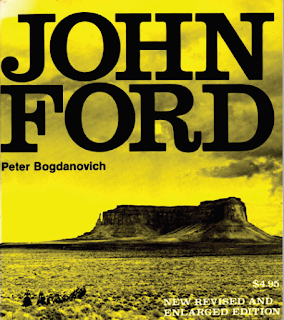
"John Ford", Peter Bogdanovich
Image
If the Nouvelle Vague became also famous for the transition of a group of film critics to the filmmaking activity, the same cannot be said of the New Hollywood, the American equivalent of the French cinematographic movement. If we look for names in the United States that, in the 60s and 70s, had similar paths to those of Godard or Truffaut, we come across essentially with two results: Paul Schrader and Peter Bogdanovich. A former writer for  Esquire magazine, Bogdanovich became latter known for the elegiac film The Last Picture Show (1971), a farewell to a generation and, in a certain way, to the classic cinema it loved, through the history of a group of adolescents in the city of Texas during the time of the Korean War. Even though he was part of a generation that re-invented American cinema, the cinephilia in Bogdanovich's early films pays beautiful homages to his masters: John Ford on The Last Picture Show and Paper Moon and Howard Hawks in What's Up, Doc? Of the...

"John Ford: The Man and His Films", Tag Gallagher

Image
John Ford (1894-1973) was, as François Truffaut wrote, "an artist who never said the word 'art,' a poet who never mentioned 'poetry.'" [1] His work is constructed on a personal and singularly lyrical vision, particularly incisive on the mythology of the Old West. His films, based on ideals of tradition, homeland, family and community, are mostly filmed in long and medium long shots, with a remarkable pictorial composition where the camera is essentially immobile. Films as  My Darling Clementine  (1946),  Stagecoach  (1939) and  The Searchers  (1956) have acquired the classic status and served as references for acclaimed filmmakers like Orson Welles (who saw  Stagecoah  forty times, while in preparation for  Citizen Kane ), Ingmar Bergman or Pedro Costa. His westerns, with cavalry figures in line, solitary heroes riding across Monument Valley, female characters waiting inside their homes for the return of their loved ones, and stretched-leg...

"Searching for John Ford", Joseph McBride

Image
John Ford (1894-1973) was, as François Truffaut wrote, "an artist who never said the word 'art,' a poet who never mentioned 'poetry.'" [1] His work is constructed on a personal and singularly lyrical vision, particularly incisive on the mythology of the Old West. His films, based on ideals of tradition, homeland, family and community, are mostly filmed in long and medium long shots, with a remarkable pictorial composition where the camera is essentially immobile. Films as My Darling Clementine  (1946), Stagecoach  (1939) and The Searchers  (1956) have acquired the classic status and served as references for acclaimed filmmakers like Orson Welles (who saw Stagecoah forty times, while in preparation for Citizen Kane ), Ingmar Bergman or Pedro Costa. His westerns, with cavalry figures in line, solitary heroes riding across Monument Valley, female characters waiting inside their homes for the return of their loved ones, and stretched-legged sheriffs sitting o...